A Traditional Wedding In China

After witnessing 2,760 kilometers of China all I wanted to do was sleep but my wife wouldn’t let me. We had just arrived in Kunming after twelve hours of travel, which by all accounts was just effortless sitting in a large comfortable chair. Yet, as any long-distance traveler knows, the sitting is the worst part. It wasn’t just normal fatigue either, I was at the onset of an aggressive cold or flu that needed a rapidly mounted defense that could only be served with a bed, pillow, and blanket. I’ve heard that flight attendants say that social rules start to break past twelve hours of travel. I was on the precipice.
From within the regional train station we headed to the taxi pick up area. Our final destination was at a nearby mall to eat dinner with the groom’s friends, who also had just arrived. But it was New Year’s Day and the crowd was insurmountable. Since the mall was only about a mile and a half away we decided to walk.
Dragging our luggage across the historic cobblestone area of Kunming would have been charming if not for my fragile condition. We had made the bold choice to purchase a tough rolling Pelican luggage container to protect the gifts we had brought for the bride’s family. We packed, among other things, several glass bottles of whiskey made locally in Utah. The toughness of the case was invaluable but came at a high cost to mobility and ease of use that only got worse with the uneven cobblestone.
After some trudging we arrived at the Shuncheng Shopping Center (顺城购物中心) and went up escalators a few stories to reach the restaurant. Everyone else had arrived about an hour earlier, flying in on fancy airplanes. We were the stragglers on our archaic 350 km/h bullet train. The group was very international, with some of the groom’s friends from Singapore and the Philippines. I’m sure their first impression of me was muted since all I did was sip herbal tea and zone out.
As we sat at dinner my wife was attempting to book our hotel in the nearby area. For some reason our original reservation had fallen through and on our walk to the restaurant she had spotted another hotel that caught her eye. While this process was playing out, the bride and groom to be both commented on my poor condition and offered to order some medicine. In my confused tired stupor I politely declined since we were about done with dinner and I didn’t want to wait long to head to the hotel. However, they politely reminded me that this was China and it would only be a matter of minutes before it arrived.
This might confuse residents of the United States or other countries but it only highlights the otherworldly capabilities of technology and the service industry in China. A few minutes later, a Meituan (美团) delivery driver in a yellow jacket walked into the restaurant with a bag from a local pharmacy and handed off the delivery. I was amazed along with the rest of the group and this sparked a broader conversation about how there were no comparisons in other countries for this convenience. The leading comparison in the United States would be a few hour delivery from Amazon to a nearby locker. But this was ordered and delivered specifically to our location in a matter of less than 10 minutes.
With medicine in hand, my wife and I headed to our hotel at the Crowne Plaza Kunming City Center (昆明中心皇冠假日酒店). As we had done in Beijing, we decided to elevate our hotel accommodations with a spacious corner suite overlooking the nearby river for ¥845 or about $120. We were overjoyed with the affordability of services in China after being repeatedly shell-shocked on all our past vacation trips. A similar hotel room would be ten or twenty times more expensive in New York City or London. To be fair, hotels and other services are rather expensive in larger Chinese cities like Shanghai and Beijing. But once you get farther off the beaten path the rates tend to dip rather rapidly. The funny thing is that Kunming’s population is about 8.5 million, which is approximately the same as New York City.

With a glorious ten hours of sleep I felt reborn the next morning. I excitedly watched the sun rise across the city and the waking population begin to crowd the streets. We quickly ate breakfast at the hotel and started our walk to meet up with the rest of the group. Our plan was to start the next stage of travel toward the bride’s home town to begin the wedding celebrations.

Ferrying yourself around in a big city in China is much like anywhere else. There exists an Uber-like application called DiDi that is extremely affordable. However, our group’s situation called for many more people and with a much longer distance to cover. The nearby Luliang County was about an hour and a half drive away and we needed several cars to fit everyone and their luggage. The bride to be ended up recruiting several DiDi drivers and negotiated a separate rate based on the fact that they were already heading back to their family after working throughout the week in Kunming. Their extra bonus was us buying them lunch at a famous duck restaurant we were planning on stopping at on the way.
Strapping luggage to the roof of some cars and Tetris-ing other bags within other cars we eventually got the caravan situated. It was a bit of shame to leave Kunming so quickly because the city seemed so charming with the fair weather and metropolitan feel. As we left the city the car was quiet due to the language barrier. There were only a few in the collective group that were fluent in Chinese and none were in our specific car. I attempted a rudimentary question to the driver with Google Translate: Could you please play your favorite music? He adjusted his radio station and a few seconds later Taylor Swift started playing over the speakers. Everyone in the car had a good laugh and I commented to my wife that no matter where I go on the planet I couldn’t escape Taylor Swift. I’ll never know if that driver was humoring me, the white American, or if he actually was a devout Swiftie.
We stopped in Yiliang County, which was about halfway to our destination, to have lunch at a regionally famous duck restaurant. Xuecheng Restaurant (学成饭店) supposedly had humble beginnings from a small restaurant but is now a multi-story and multi-building compound that could seat hundreds. The bride to be commented that whenever they drive back home they stop at this restaurant.
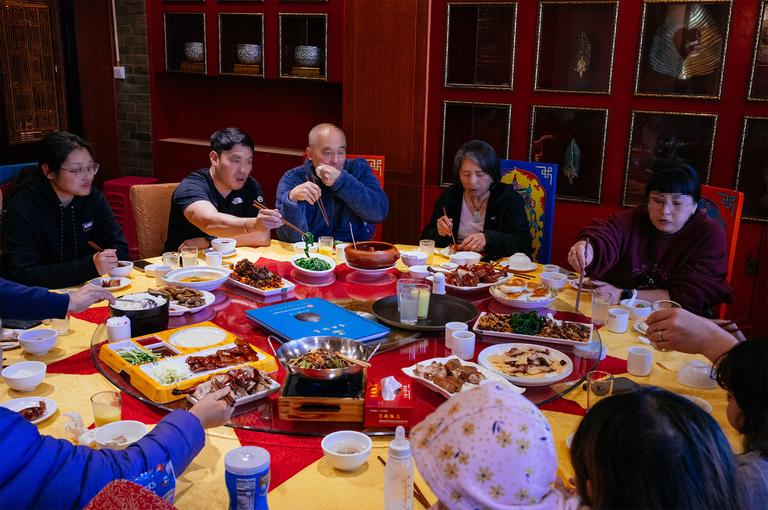
We were ushered into a large room and seated at a giant table that had an equally oversized Lazy Susan. After a flurry of ordering in Chinese the dishes started arriving. Their famous roast duck, vegetables of various preparation, squash soups, steaming dumplings, and a multitude of other dishes. Up to this point in the trip there had been a sort of boring average of food dishes that didn’t live up to the exotic stereotypes of Chinese cuisine. In an attempt to push the culinary boundary for myself and the rest of the group I scoured the menu for something more outside the standard Western diet. I was rewarded on a random page, which had a dish that included bamboo larva, adolescent bees, and silk worms. All deep fried. Disregarding wide opposition from the rest of the group we ordered the teenage bee dish, which ended up being rather delicious with the texture and taste of over cooked popcorn.
Throughout this whole time my wife was admiring the finely crafted menu they had provided. It was a large fabric bound catalog with color images of all the dishes available to order. She mentioned to the bride to be, half joking and fully serious, if we could ask the staff if we could buy one of the menu catalogs. After asking a staff member over I could see the exact second the conversation reached the unusual question. With raised eyebrows and mouth agape the staff person stammered a bit and then went off to get a manager. Once the manager returned the bride to be attempted a spirited negotiation to purchase the catalog but was rebuffed, even at two to three times the expected price. I have no idea what that price range would be but it ended up being more about the staff suspecting us of being rival business spies that would copy elements of their wildly successful restaurant.

Once we were done eating we met up with our DiDi drivers, who were eating at a separate place within the restaurant and started the last half of the drive towards Luliang County. The drive gave a great presentation of the region’s geography and insight into normal travel in rural China. Between Yiliang County and Luliang County there is the Stone Forest National Geological Park (石林风景名胜区). We could see parts of it from the highway but didn’t stop since we had to make it to the family’s house for the ceremonies to start. They were all waiting for the international group to arrive.
As we drove into Luliang County I could see why the bride to be described it as the countryside. In the comparative context next to Kunming it was incredibly small at only 610,000 people. But this minor city was still larger than my hometown of Salt Lake City in Utah. Furthermore, there were the hallmarks of Chinese civil infrastructure all over with wide highway boulevards, industrial factories, and an energetic commercial downtown.
Traversing across the bustling heart of the city gave way to agrarian buildings. Thousands of greenhouses for miles in every direction supercharged the growing capabilities for the farmers in the area. It was hardly necessary since the weather was so fair. I had kept my winter coat on hand since we left Beijing but it had been left unworn since arriving in Kunming. A simple shirt and pants were suitable during the daytime. The weather was comparable to something between Los Angeles and San Diego in the winter.
The local family’s house was on an unmarked narrowly paved road next to a canal. A small neighborhood surrounded by fields and fields of greenhouses. I was sitting in the front passenger seat of the DiDi and was first to spot the celebrating house. Red traditional adornments were plenty to signify the occasion. The most common was the Chinese character for double happiness, 囍. The house itself was busy with people milling about but there was also a pavilion just down the street where there was even more people.
The DiDi vehicles parked and we began to unload all the luggage while the bride to be’s family welcomed and greeted our group. Since there were only two people in the entire group that understood Mandarin and English our ability to communicate was limited and we all deferred to warm smiles and patience as the relevant information of who was who got translated to either side. As this was happening, I saw the local uncles unfurling a more than fifty-foot red ribbon in the middle of the road. I would find out later it was not actually a ribbon.
With the pleasantries wrapping up we were shooed about a hundred feet down the street to a neighborhood pavilion where party preparation was ongoing. Our group wasn’t exactly sure what was happening since our designated translators had been occupied elsewhere. With a short walk we arrived to the covered and crowded pavilion. I quickly realized this was the food preparation headquarters because near the front were several low tables displaying the butchered sections of an immensely large pig. However, I would soon learn that the pig had alternative purposes, at least initially. Towards the back of the pavilion I could see people hard at work processing and cooking food. There were giant stands made out of cinderblocks with propane burners firing up impressively large woks and steamers. The scale of preparation was just immense.
Bride Price (聘金)
While admiring the industry of food there was a bit of commotion at the pavilion entrance. The uncles were yelling at each other as they circled the tables with the pig. But they weren’t yelling, they were coordinating. With a collective lift, all the tables were hoisted up and started their exit from the pavilion and towards the bride’s house. At the same time rapid gunshots started to ring out at our destination. The red ribbons, which I found out later were several different fifty foot strands, were actually Chinese firecrackers (baozhu 爆竹). As someone who has repeatedly experienced fireworks in the United States I had thought I was prepared for any other country’s flavor of fireworks. But Chinese firecrackers are especially violent and are quite disarming.

The procession reached and entered the bride’s home. People crowded in to watch the ceremony unfold. The tables were placed together on the floor near a small shrine in the living room. I asked the groom what the shrine was about. He explained that it was for the family’s ancestors, which they paid respects to almost daily. He pointed out several cigarettes speared by incense sticks that were burning. These were the favorite cigarettes of the great grandmother, he explained, and that was how they honored her.
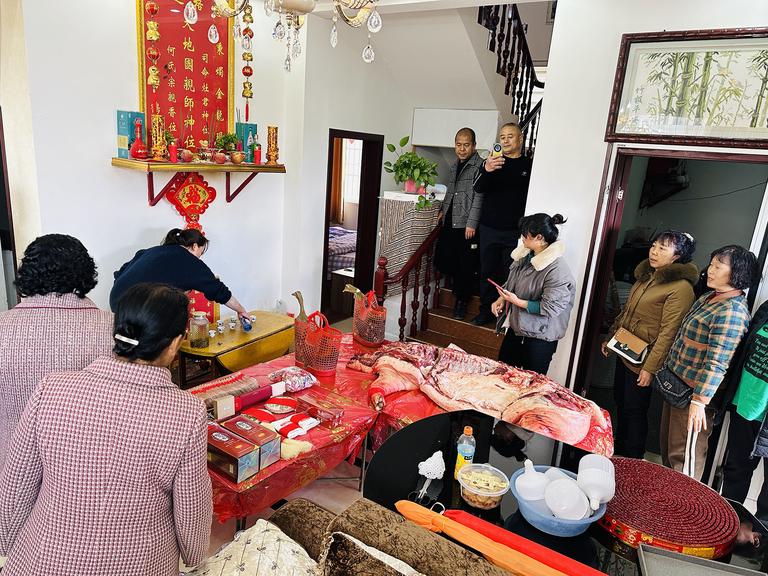
With the tables arranged together in front of the shrine, a ceremony began to unfold. As the family spoke in Mandarin my eyes wandered to the contents of the table, which had items I didn’t notice before. In all fairness to myself, a giant butchered pig is extremely visually distracting. Regardless, I began to identify other neatly arranged items on the tables. There was 24 karat gold jewelry, high end baijiu alcohol, large discs of dry aged pu’er black tea, chickens, ducks, and a very large stack of cash. Prayers written on paper were lit on fire and placed in a metal bin before the family’s shrine. A few more words were spoken and then it was all over. People dispersed and the pig was taken away to be refrigerated.
The rest of the foreign group and I had so many questions but the bride and groom were busy talking to the future in-laws. Another mini-ceremony of exchanging gifts was taking place, which left the groom with a surprised expression on his face. When he finally came over to the group to explain the events of the past thirty minutes he explained that the bride’s family had just given them a house in the nearby city of Kunming. He further clarified that this was normally a gift provided by the groom or his family but since he was from the United States the local family wanted to provide this key component for them.

Further explanation for the rest of the prior ceremony followed. Apparently, the procession towards the bride’s home was the groom’s payment of the bride price (pìn jīn 聘金) in addition to the dowry ceremony (jiàzhuāng 嫁妆).
The bride price is something traditionally put together by the groom and offered to the bride’s family. The value of this gift expresses the serious intent for marriage and also publicly advertises a certain level of social clout for both the groom and bride’s family to the rest of the community. The bulk of what was presented on the tables was this bride price. In overall value, it equaled to about a mid-five figure amount in United States dollars. This gift is kept by the bride’s family for a period of time, usually a few years, as an insurance policy in case the groom mistreats or divorces the bride. After that time has elapsed without issue, the amount is usually given back to the groom and bride.
The dowry was also included in this ceremony. In Chinese tradition the bride’s family presents gifts in response to the bride price being paid. In this case, it was a return of a small portion of cash from the bride price and the house in Kunming.
As the formalities of the day were over the local family invited us to relax in their home for the next few hours while the first evening’s feast was prepared. Some of our group relaxed and took naps on the couch while other, more adventurous members like my wife, went outside to explore the surrounding neighborhood.
The wedding festivities had attracted kids from the surrounding houses and they were zipping up and down the narrow street on their electric scooters. My wife got the attention of a few kids and convinced them to let her borrow one of them to explore the neighborhood with ease. The endeavor looked fun, but having missed my runs for the past few days, I chose to walk while my wife zoomed through the streets.

The surrounding farmland was a collection of lush fields with a variety of crops. For the fields that weren’t covered by greenhouses I could see cabbages, artichokes, and lettuce growing. Many of the homes reminded me of Idaho, in the United States, with a practical and pragmatic approach to fortifying the structure. It was charming and reminded me of my childhood spending time at my Grandmother’s ranch outside Soda Springs, Idaho.

As I made my walking loop back towards the wedding home I slowly caught up to an older lady biking on a tricycle. Once I got next to her I gave her a hearty nǐ hǎo! (你好) to say hello. She looked at me for a second and then just let out a loud belly laugh and kept laughing as I continued walking past her. Now, you’ll have to take a second to understand the insane context of this situation. Here I am, the only white person in probably a hundred miles in any direction. On top of that, I am walking by myself far away from any tourist or major population center. It would be like seeing an English gentlemen strolling through a cornfield in Nebraska.

The first dinner feast was starting when I got back from my walk. The bride gave us all a disclaimer that it wasn’t a respectable feast, at least compared to the dinners planned for later. She said this specific meal was meant to be a rather simple one as a reward for the workers who were preparing food over the course of the wedding celebrations. But no one in the foreign group or I could tell this was anything short of decadent. The meal consisted of roast duck, steamed chicken, cabbage stir fry, daikon pork soup, lettuce rice wraps, pork soup, fried peanuts, broccoli stir fry, white rice, braised pork soup, and two kinds of hot sauce. We found out while eating that it is a Chinese cultural necessity to plate a number of unique dishes equal to the number of people sitting at a table plus one. So in our case, we had 8 people at our table and 9 unique dishes.
Ganbei! (干杯)
At the conclusion of dinner, the celebration shifted gears from culinary appreciation to aggressive alcoholic debauchery. The local uncles descended on our table carrying blue bottles of báijiǔ (白酒), a ubiquitous Chinese spirit with an alcohol content hovering near 60 percent.
The bride explained that the uncles wished to toast our arrival and thank us for traveling so far. There was, however, a catch. The majority of our foreign contingent, including the groom’s parents and extended family, did not drink for religious reasons. Looking to us with a mix of hope and apology, the bride asked if my wife and I would serve as tributes in their place. I wanted to be a hero but my wife was more apprehensive. We agreed. Little did I know that saying “yes” would inaugurate a marathon.
We received small paper cups filled with the clear liquid. “Ganbei!” (干杯) the uncles yelled. I took a polite sip. It tasted like strong Japanese sake mixed with vodka. The groom noticed my small sip and corrected me, saying that I had to consume the entire cup whenever the toast-giver says ganbei, as it literally translates to dry cup. Right after finishing the cup an uncle immediately attacked it, refilling to the same point. I could see the momentum for the evening building up quickly and I could only mutter, “dear God” loud enough for my wife to hear as I looked at her with excited apprehension.
As this was happening the pavilion was reconfigured. Dinner dishes were consolidated and coupled with drinking snacks such as local fruits and peanuts. Boxes of baijiu and Chinese beer were stacked around the tables like a wall of easy access.
What followed was a pyramid scheme of drinking in a race to intoxication. My wife and I relocated with the groom and bride to a table with the uncles. They invited us to eat snacks while we drank and to pace ourselves. However, this seemed more like a loose recommendation rather than actual practice. What followed was that members of a certain table would travel as a group together to the other tables. Stopping at each one to toast that table and honor them. This process repeated as other tables got up and did their respective rounds to all the other tables. Each cycle splashing more and more baijiu down my throat. The yelling of ganbei was only interrupted by other ganbei’s. In some cases, the uncles were competing with one another by accomplishing certain feats of drinking. One would finish off the last of an entire baijiu bottle and claim the other had to catch up.

I had never consumed this much alcohol in my life. I’m normally impacted by alcohol rather rapidly and this was no different. However, on a sustained level I thought I was operating with some functionality. That is, until the uncles noticed I had trouble sitting up at the table. They quickly switched me to light beer and urged me to eat more snacks. The toasting continued with the light beer and it thankfully didn’t hit nearly as hard as the baijiu.
One thing I did learn from this experience was the social etiquette behind toasting in Chinese culture. Like many things in Asian society, it required you being aware of your age and standing in relation to the person you were toasting with. Based on that dynamic, you would clink your glass together at a lower point if the other person was more senior. This got a bit tricky because the senior person often placed their hand below your cup and would prevent you from going lower. In my intoxicated state I took this cultural norm a step further by going ridiculously lower than the other person’s cup. In some cases, all the way to the ground, which made the bride’s mother laugh on more than one occasion.
Although it seemed longer, the drinking marathon only lasted about two and half hours after a 5 p.m. dinner. I really appreciated their punctual method since it gave me time to coast off a bit of intoxication prior to bedtime. After drinking in the pavilion we moved back to the house to start singing karaoke. The bulk of songs available in the system were Chinese but there were a few standout hits from the United States, including Celine Dion’s “My Heart Will Go On” and Aqua’s “Barbie Girl.”

When the evening finally wrapped up the bride’s local family ferried our group to a local hotel that one of the uncles had rented out for the wedding. It was a few miles away in the downtown area. My wife and I slammed down several bottles of water and some electrolytes before going to bed to stave off a severe hangover in the morning.
The following day I felt ambitious enough to go on a 8.22-mile jog along the nearby Nanpan River before our planned late breakfast at a local hot-pot restaurant. To make it back to the area where my hotel was I had to go through an industrial section of the city, which led to many weird looks from the locals. A white man in a fluorescent yellow jacket dodging large transport trucks on a tight road. On the last section of my run before crossing the river I did get a surprising cheer from a local at a farmer’s supply store who yelled out in rather good English, “Good job!”
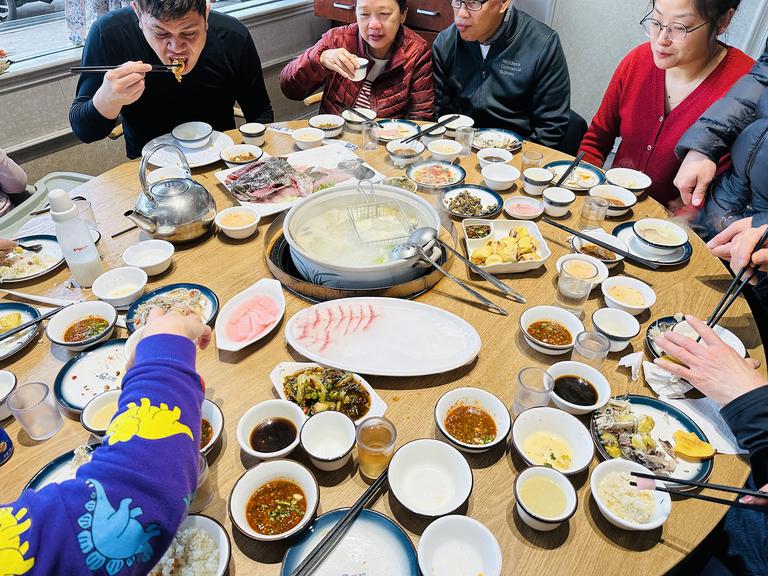
About an hour later we were sitting at a local fish hot-pot restaurant. It was the most perfect meal since the weather had cooled off dramatically into the 40s Fahrenheit on top of a growing fatigue from the previous evening’s drinking. Perhaps I have overdone it with the longer morning run when I should have rested for recovery. A steamy hot fish soup broth was basically nirvana at that point.
The rest of the second day held no specific events for the wedding itself. The remaining friends of the groom arrived from Singapore at around dinner time, which we ate at the pavilion near the bride’s home. Towards the end of dinner the uncles wanted to drink again to celebrate the groom’s friends arriving. However, after recounting the story of last night the groom’s friends pleaded to defer any drinking to the next day for the culmination of celebration. I happily joined in this pleading as I was beginning to really feel the impact of the first night’s drinking.
Gatecrash
Early on the third day we began with the wedding gatecrash. The start time for most wedding events are fit to auspicious times as determined from traditional Chinese numerology and astrology. Fortunately for us, this couple’s start time was at a semi-normal 8:30 a.m. but I was told about some couples that had to start at three or four in the morning. Additionally, I refer to this ceremony as gatecrash because of the groom’s Singaporean heritage. In mainland China, however, it is colloquially known as jiēqīn yóuxì (接亲游戏), or games to receive the groom, and sometimes dǔmén yóuxì (堵门游戏), games to block the door.
Because the groom was American and lacked a local home, the logistics of the ceremony were adapted. Instead of the traditional procession from the groom’s house to the bride’s house, the family stationed the bride at the rented hotel downtown. This would allow the ceremony to conclude at her family’s home.
The gatecrashing began with the groom’s entourage storming the hotel. Upon reaching the entrance, they hit a wall of the bride’s male relatives. Pleading was useless and moved no one. This is a boisterous and loud affair. The only language understood here was the red envelope. The groomsmen slid envelopes containing small amounts of yuan to the guards until the human barricade dissolved enough for them to pass by. The friction set the tone for the rest of the games as a gauntlet for the groom to prove his dedication and love for the bride.
On the third floor, the bridesmaids launched their first volley. They presented a napkin marked with five distinct lipstick prints taped to the door. The groom’s task was to identify his bride’s lips.
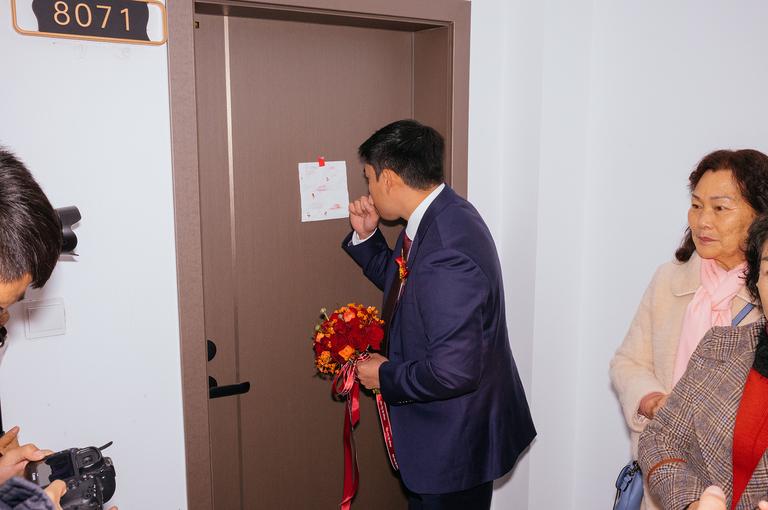
Even after solving the puzzle, the door remained shut. The bridesmaids demanded a toll. Only after sliding a thicker stack of red envelopes under the door did the barrier finally open. We crammed into the hotel room to spectate. The bride sat quietly on the bed in her striking red wedding dress, while her bridesmaids acted as generals conducting a grand defense. They sternly and loudly present the terms to the groom and the groomsmen.

The first battery was trivia. What was the exact date of their first date? What is her favorite tea shop in Kunming? How many text messages did you send her last month? The groom knew some but others required frantic investigating on his phone. When he faltered, the bridesmaids demanded immediate financial penalties with additional red envelopes.

Next, the groomsmen had to craft a message of love using only their teeth. They were given slices of white bread and sixty seconds to nibble each piece into legible characters. They opted for English to keep it simple, producing an unoriginal “I LOVE U.”
The final challenge tested agility. The bridesmaids plastered the suited groomsmen with sticky notes, then gave them one minute to shake them off without using their hands. The room erupted in laughter as the men gyrated and jiggled to dislodge the paper. Despite some questionable tactics to beat the clock, the bridesmaids mercifully accepted the victory. The groom then swept the bride into his arms, carrying her out of the hotel to head for the tea ceremony. With the conclusion of the games the bride was carried by the groom out of the room and out of the hotel. Their next destination was the local family home to take pictures and lastly, perform the tea ceremony.

Ferrying a large amount of people from the hotel back to the family’s home took some time even with the recruitment of a few additional DiDi drivers. My wife was finally successful in getting a DiDi driver arranged through WeChat. She had spent the past few days incorporating her credit card and passport into the gauntlet of WeChat but had to deal with additional scrutiny because she was foreign. But at least we now had a tiny bit more autonomy to move around by calling whichever DiDi ride was needed.
Tea Ceremony
After some wedding pictures the family started setting up for the tea ceremony (jìng chá 敬茶). A velvety red cushion placed on the floor in front of two chairs in the middle of the room. It would be the last and probably most endearing ceremony that highlights the structure of filial piety in Chinese culture. The process basically has the bride and groom offering tea to their family elders and are in turn bestowed with gifts and well wishes. Yet the ceremony defines the actual emotional precipice where the couple is married. The amount of tears and sniffling was certainly a testament to that realization for me and other foreigners. Almost as if the previous ceremonies and celebrations were just a lot of fun the family was having together but now it was a serious culmination to the entire wedding.
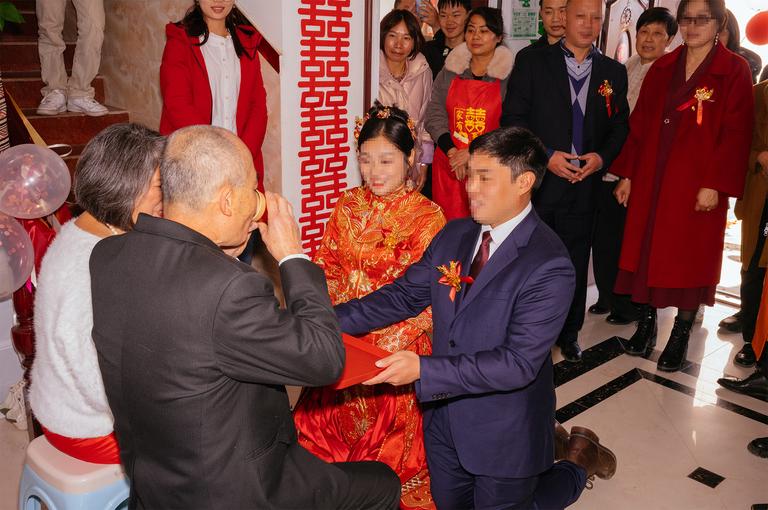
At first, it was the oldest family elders. The bride and groom presented tea to them and said a few formal words, which responded to by the elders and a gift. This was usually a red envelope but also included some openly displayed gifts, 24-karat gold jewelry, or stacks of yuan bills wrapped in red ribbon. Then came the turn of the parents. This was challenging for a few of them. The bride was oldest and the parents had no practice giving away their children to a new life. Lastly came aunts and uncles and then important relations to the family.
I was part of that last category. It was a good venue to formally inaugurate my wife’s and my entrance into their social hierarchy. Although our gifts to the couple were standard, cash and a 24-karat gold bracelet, we possessed an unexpected advantage: my ethnicity. Another element of all these ceremonies is that they take place in public and rely on generating clout for both the bride and also the groom’s family. Everyone can see the thickness of the red envelopes given by each guest. They can also see how many items of 24-karat gold are on the tray when gifted to the bride. These are sometimes referred to as mianzi (面子) and or lian (臉) with the loose English connotation of saving face. Another ingredient in this formula was how many foreigners traveled across the world to attend a wedding. Wow, you must be so important and loved! Thus, for the first time in my life, my skin color was used to increase the social standing of a few people.
I received some coaching prior to taking a seat in front of the couple. I was instructed to say chá shì tián de (茶是甜的) after receiving the cup of tea from the bride. This approximately translates to saying that the tea is sweet. I received the cup. I drank a bit. I struggled to say the phrase since I was so nervous. There were a few giggles from the gathered family and perhaps I said something ridiculous or sounded like Brad Pitt in Inglourious Basterds but at least my part in the ceremony was over.
A grand feast started after the tea ceremony where the level of fanciness had increased quite a bit. Now the tables were covered in a nicer red synthetic fabric rather than plastic. The cups were red and gold while the main courses were meant to showcase all of the hard work of the event staff preparing dishes over the past several days.
With the new foreign arrivals from Singapore, the local uncles had another group to focus on for celebratory drinking games. There was another pyramid cycle of Ganbei! shots as groups toasted to different tables. It wasn’t quite the level of debauchery as the first evening but there were still several casualties. A few people from the Singapore group threw up from the amount of drinking and thereafter hid away in a bedroom upstairs to avoid the pressure from the local uncles. We didn’t stay up terribly late into the evening. In part because the hard drinking tapered off at around 7:30 p.m. and also because we’d be moving on to Lijiang early the next day.
⁂